
SAN JUAN CITY, [July 28, 2026] — The Department of Finance has confirmed in writing that digital and electronic books remain exempt from value-added tax under Republic Act No. 12023, and that this has been the Department’s position since the law was deliberated in Congress.
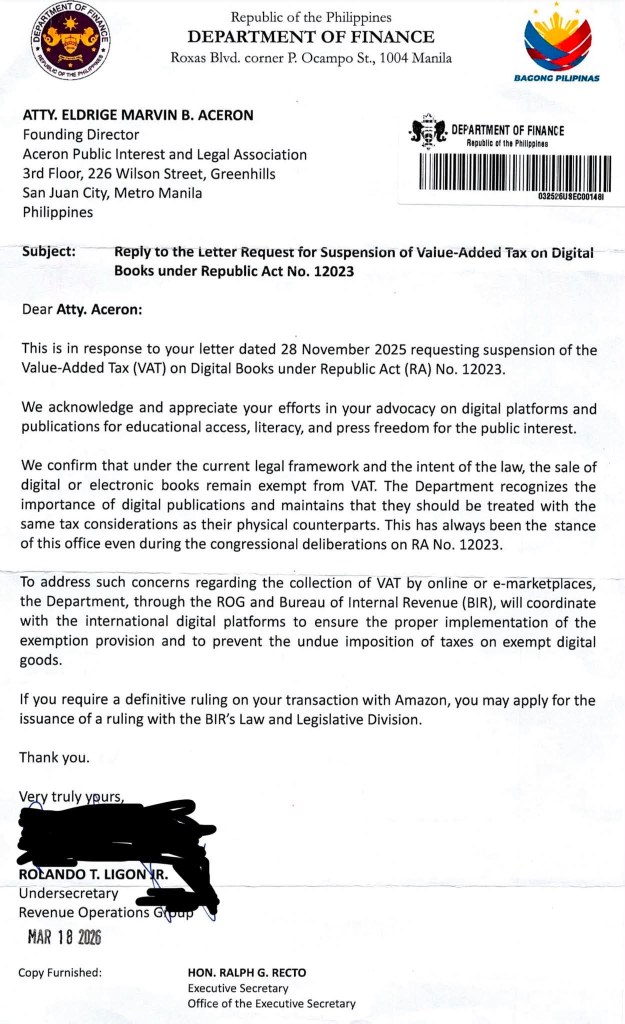
The confirmation came in a letter signed by Undersecretary Rolando T. Ligon, Jr. of the Revenue Operations Group, responding to a request filed by the Aceron Public Interest and Legal Association (APILA) in November 2025. The Department stated that digital publications should be treated with the same tax considerations as their physical counterparts, and that the Revenue Operations Group and the Bureau of Internal Revenue will coordinate with international digital platforms to ensure the exemption is properly implemented and to prevent the undue imposition of taxes on exempt digital goods.
APILA is the public interest arm of Aceron & Attorneys. Its work on the digital books case is initiated and supported by the Kwan Laurel Fund.
APILA is transmitting the letter to the Supreme Court, where its petition challenging the imposition of VAT on digital books — filed with National Artist for Literature Virgilio S. Almario as lead petitioner — remains pending.
“The Department has said plainly what the law already says: a book is a book, whether it is bound or downloaded,” said Atty. Eldrige Marvin B. Aceron, Founding Director of APILA and counsel for the petitioners. “We are grateful for the clarity. But Filipino readers are still being charged VAT at checkout, and a letter of comfort does not reach a foreign marketplace’s tax engine. That is why the petition stands.”
APILA said it will also apply for a definitive ruling from the BIR’s Law and Legislative Division, as the Department suggested, while pursuing the case before the Court.
The organization emphasized that the issue is one of access. Digital editions are often the only affordable or available format for students, teachers, and readers outside major urban centers, and for Filipino readers abroad. Taxing the digital edition of a book that would be exempt in print, APILA said, penalizes precisely those readers with the fewest alternatives — a result inconsistent with the constitutional policy favoring education and with the Philippines’ commitments under the Florence Agreement on the importation of educational, scientific and cultural materials.

