BANGKOK, THAILAND — Indonesian research institutions, grassroots organizations, and policy experts presented a transformative economic blueprint at Bangkok Climate Action Week (BKKCAW) 2026. The proposed “restorative economy” framework provides Southeast Asia with a practical roadmap to shift away from traditional resource extraction toward economic systems that actively replenish natural ecosystems.
Centering around the BKKCAW theme, “Economy We Shape, Climate We Share,” the delegation demonstrated how nature restoration can transition from isolated local projects into scalable, mainstream economic models across ASEAN nations.
Billion-Dollar Economic Output and Reduced Inequality
New research from the Center of Economic and Law Studies (CELIOS) highlights the immense economic potential of this approach. According to CELIOS, implementing restorative economic practices in Indonesia alone could generate Rp 2,208 trillion (approx. ₱8 trillion / US$140+ billion) in national economic output over the next 25 years, while simultaneously narrowing income inequality by 15%.
This framework offers a critical blueprint for neighboring countries like the Philippines—one of the world’s most climate-vulnerable nations. With Philippine national climate expenditures topping ₱1.16 trillion annually and long-term adaptation financing needs nearing US$100 billion through 2040, the Indonesian model shows how community-led restoration across thousands of villages can build resilience while driving local commerce.
The urgency of this shift follows months of severe climate impacts across Southeast Asia, from destructive urban flooding in Metro Manila, Luzon, Visayas, Bangkok, and Johor Bahru, to severe forest fires across Sumatra, Kalimantan, and Papua.
Rethinking Green Finance and Fiscal Policy
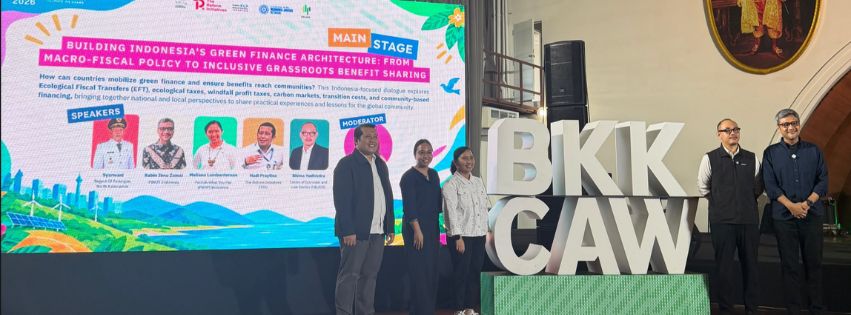
A key session hosted by CELIOS, PINUS Indonesia, The Reform Initiatives, and Publish What You Pay Indonesia titled “Building Indonesia’s Green Finance Architecture” focused on restructuring macro-fiscal policy to support grassroots initiatives.
The panel highlighted instruments like Ecological Fiscal Transfers (EFT)—currently utilized across 43 subnational governments in Indonesia—to align fiscal revenues with environmental performance.
“We must elevate the nature-based economy beyond basic conservation and position it at the center of national economic strategy,” said Bhima Yudhistira, Executive Director of CELIOS. “Through equitable fiscal mechanisms and transparent benefit-sharing, we can attract capital while ensuring transition dividends directly enrich local communities on the frontline.”
Watershed Regeneration and Agroforestry
Focusing on landscape-level solutions, Cendekia Iklim Indonesia (CII) presented “Wealth That Flows: Building Prosperity Through Watershed Regeneration in Southeast Asia.” The program showcased how agroforestry—such as coffee and macadamia cultivation in Thailand’s Doi Tung region—can restore critical watersheds while securing sustainable livelihoods for rural populations.
CII emphasized that nature restoration is a value-generating investment rather than an ongoing cost, offering a scalable economic playbook for the Mekong and broader ASEAN regions.
Global South Collaboration
Meanwhile, the Nature-Based Economy Pavilion at Lumpini Park, organized by Koalisi Ekonomi Membumi (KEM), brought together social entrepreneurs, impact investors, and policymakers from across the Global South to connect local bioeconomy producers directly with capital and policy networks.
“Climate action strategies cannot operate in isolation; they require active, cross-sector collaboration,” said Fito Rahdianto, Executive Director of KEM. “If dreaming of a better world feels too abstract, we can at least offer a new perspective to imagine life beyond the extractive systems we inherited.”
By combining fiscal reform, sustainable agroforestry, and inclusive green financing, the participating organizations demonstrated that economic growth and ecological restoration can work hand in hand across Southeast Asia.

