February 2026 — The International Conference Series on Next-Gen Technologies and Innovation (InnoVision) is now in its second year. It has launched a new series called InnoVision 2026 Campus Series, which aims to train students and educators in Generative AI skills, strengthenindustry-academe collaboration, provide international exposure to Filipino learners, build innovation pathways for startups and researchers, and expand partnerships across ASEAN universities. It continues to grow into one of the country’s most progressive technology upskilling initiatives, gathering more than 1,000 students and faculty across five partner campuses through a combination of conference sessions and Generative AI certification workshops.
Led by Philippine Coding Camp (PCC), the main driver of the initiative, InnoVision reinforces its mission to bridge the gap between academia and industry and to prepare Filipinos to compete globally in the digital economy. This year’s expanded Campus Series reflects a stronger regional vision—connecting universities, industry leaders, and international partners across ASEAN.
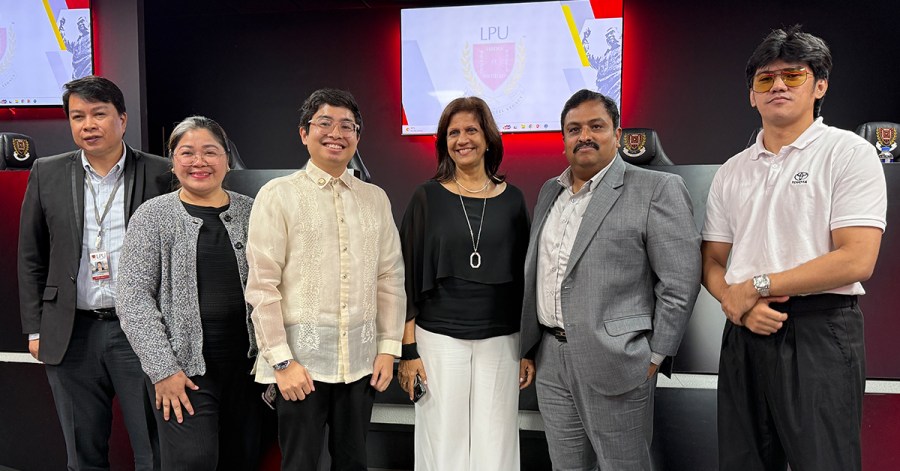
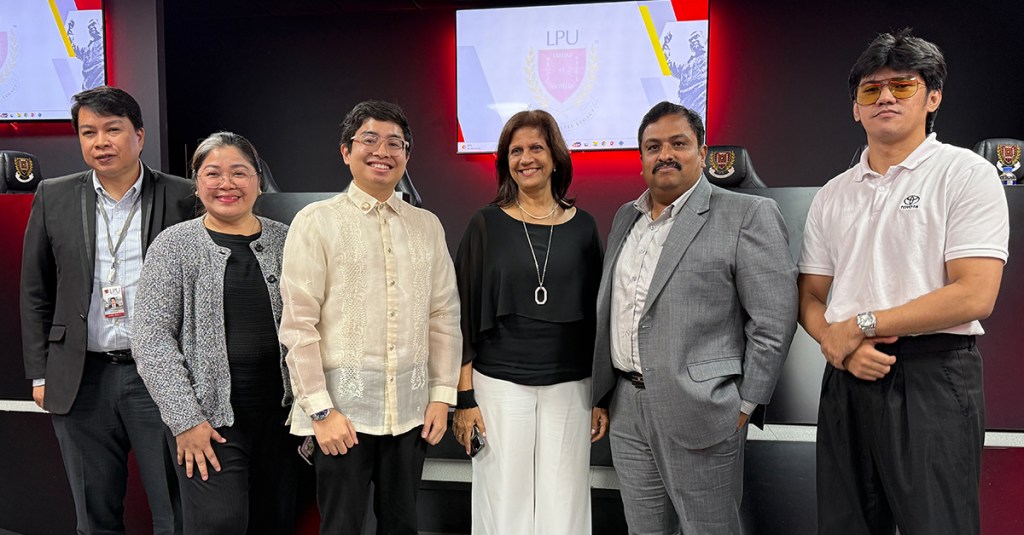
Present at the media conference were Prof. Arun Kumar Sangaiah, a distinguished professor from the National Yunlin University of Science and Technology (Taiwan), Prof. Abtar Darshan Singh, the UNESCO Chair from Asia Pacific University (Malaysia), Dr. Mark Celis of Lyceum of the Philippines – Cavite, Dean Arlene Caballero of Lyceum of the Philippines – Manila, Engr. Eliseo Cacalda III of Toyota Philippines and Dr. Gabriel Sampedro, founder and CEO of Philippine Coding Camp.
What’s the scope of the partnership of Philippine Coding Camp (PCC) with LPU?
“Our partnership with LPU was inked sometime this year were the partnership agreement was basically to run events such as InnoVision. So basically, the whole goal of InnoVision is to expose students to what’s happening in the real world. One of the problems that we’ve seen in the academics is that we tend to lack exposure in terms of industry knowledge. That’s why with events like this, we bring together experts, not just from the Philippines, but also experts from Malaysia, Indonesia, and Taiwan, here in the Philippines to share their expertise in their field of work,” Dr. Gabriel Sampedro shares.
“Aside from the student exposure and mentorship program, we wanted to collaborate in terms of developing and join in offering courses and training and seminars for our students, especially in the era of Generative AI for LPU,” LPU Manila dean, Ms. Arlene Caballero adds.
Since the launch last year in La Salle, how was the turnout for InnoVision, and what are the future plans?
“The main goal of our launch last year is really to spread to different universities in the Philippines. So, in this week, this is part of our campus series, we’re doing different workshops, as well as conferences at universities. We’ve had one recently at the University of Eastern Pangasinan, and we’ve had training sessions with the Philippine Military Academy in Baguio. Today at Lyceum of the Philippines University of Manila, as well as Marikina Polytechnic College. Tomorrow is going to be at the Lyceum of the Philippines University – Cavite. Part of our plans would also be to host an international conference called the ASEAN Stakeholders Summit of Generative AI for Education. It’s a conference that brings together different experts from different ASEAN nation and it has been going on for two years. This year would be our third year. In the last two years, we’ve held it at Kuala Lumpur, Malaysia, and it’s the first year outside of Malaysia and we’re doing it here in the Philippines, especially since the Philippines is the ASEAN chair. During the conference, we’ll be gathering different experts, we’ll be sparking conversations and the main goal is not just an academic conference per se or presentation, but rather the main goal is really to push for progress, push for policy-making as we will be inviting government as well as different industry people to this whole stage. This is in partnership with the Asia Pacific University in Malaysia,” Dr. Sampedro answers.
How important is the UNESCO partnership in shaping the curriculum and what was the experience with the conference in University of Eastern Pangasinan?
“First of all, the APU UNESCO chair’s mandate from Paris is use of innovative technologies to enhance the quality of teaching and learning. We’re in the fourth year of our UNESCO chair now, to give you a bigger picture, the UNESCO chair has been very active in the AI mandate, especially the use of AI in enhancing teaching and learning, both for students and for professors. And since 2023, we have trained more than a thousand people in more than 25 countries on the use of AI. Now, the important thing to remember is how we can ensure AI is used in the correct way. As Dr. Sampedro mentioned, a lot of students and lecturers do not have the complete picture of how Generative AI can be used correctly. So, we have come up with the CPRV framework, which allows us to take students and professors in a step-by-step manner in how to create. For example, for professors, how do you create lessons that does not require to much of your time but you have all the knowledge, you are the subject matter. So, how do you capitalize on AI? How do you do your research? How do you use AI to support you in your research? How do you use AI to create meaningful assessments and good grades and how to become an AI champion? This is what we are covering using our framework C for Context, P for Prompting, R for Refine and V for Validation. The validation is the most important part that we are promoting for the enhancement of the critical and creative thinking aspects of the students,” Prof. Singh shares.
“To answer your second question, the last two days have been just amazing. What we found out, our participants from the Philippines, they are very interested, they are very engaging and in fact, some of them, they forgot (to take) their lunch to get to learn more as much as they could. It was highly inspirational for me and my other colleagues which are also UNESCO partner, just like Dr. Sampedro is. And through these partnerships, we believe very highly that ASEAN as a region, is full of knowledge, skill sets and competency but we haven’t maximized it yet. We haven’t maximized what we have and we feel Generative AI is a leveling field for us, it can level us up. Some countries that are still unable to be there in terms of learning research, we are hoping that through our little conventions, these countries will eventually will be at par,” Prof. Singh continues.
How was the partnership with UNESCO an advantage for PCC?
“The UNESCO partnership was very engaging. It allowed us to share our expertise with different stakeholders. Actually, one interesting case was yesterday at the Philippine Military Academy. In terms of PMA, of course, they value integrity, and in terms of integrity, Generative AI is still a grey area. At least we’ve had interesting conversations with people like their general and their faculty members. We’re basically trying to give people a different perspective of this new kind of technology, from using AI to cheat, to using AI to amplify your work. The reception was very great, and it was clear that everyone was engaged and learned a great deal. You know, after the training, it’s just the beginning. There’s a lot more to be done and we’ll be here to support them,” Dr. Sampedro shares.
The highlight of the program is the Generative AI Certification Workshop, delivered in partnership with the UNESCO Chair on Harnessing Innovations in Technology to Support Teachers and Quality Learning at the Asia Pacific University of Technology & Innovation (APU), Malaysia, whose experts traveled to the Philippines to lead hands-on sessions with educators and students. The workshop equips participants with practical tools to integrate AI into teaching, research, entrepreneurship, and industry innovation.
The Campus Series is being hosted across five university campuses, namely the University of Eastern Pangasinan, Philippine Military Academy, the Lyceum of the Philippines University Manila, the Marikina Polytechnic College, and Lyceum of the Philippines University Cavite, where participants engage in keynote talks from industry and academe leaders, hands-on Generative AI workshops, and collaboration sessions that connect local talent to ASEAN opportunities.
With partners from academia, government, and industry—including international universities, technology companies, and professional organizations—InnoVision 2026 continues to position the Philippines as an active contributor to ASEAN’s innovation ecosystem.
As Philippine Coding Camp expands its regional collaborations, the initiative aims to strengthen micro-credentialing programs, industry-academe partnerships, and global learning pathways for Filipino students and educators.
The vision remains clear: to make Filipinos globally competitive by bridging academia and industry—now on a larger scale, across ASEAN, with the Philippine Coding Camp at the forefront of digital transformation.
About InnoVision Campus Series
InnoVision is a nationwide technology conference and training initiative organized by Philippine Coding Camp, bringing together universities, industry leaders, and international partners to deliver cutting-edge training in Generative AI, emerging technologies, and digital innovation.
Key Details
● Dates
○ February 16, 2026 – University of Eastern Pangasinan (Binalonan, Pangasinan)
○ February 17, 2026 – Philippine Military Academy (Baguio City)
○ February 18-19, 2026 – Lyceum of the Philippines University – Manila
○ February 18, 2026 – Marikina Polytechnic College
○ February 19-20, 2026 – Lyceum of the Philippines University – Cavite
● Speakers
○ https://innovision.philippinecoding.com/conference/speakers
● Partners
○ UNESCO Chair on Harnessing Innovations in Technology to Support Teachers and Quality Learning at the Asia Pacific University of Technology & Innovation (APU), Malaysia
● Sponsors
○ Philippine Space Agency
○ Bank of the Philippine Islands and BPI Vybe
○ Kalibrr
○ Leave a Nest Philippines
○ AWS User Group Philippines and AWS User Group Pangasinan
○ Institute of Computer Engineers of the Philippines (ICpEP) – NCR
○ Korean Institute of Communications and Information Sciences
About Philippine Coding Camp
Philippine Coding Camp is a technology education and micro-credentialing organization dedicated to equipping Filipinos with globally relevant skills through boot camps, corporate training, and large-scale conferences such as InnoVision.
 HYPE MANIA